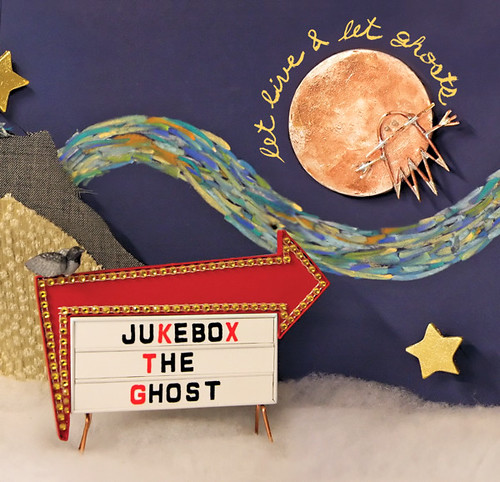
Jukebox the Ghost: Let Live and Let Ghosts
[Rebel Group 2008]
7/10
Who likes opening bands? Generally, I don’t. God bless them for getting out there and pounding the circuits, but frankly, I’m usually not there to see them, and they’ll be lucky if I can remember a melody of there’s at night’s end. So as Jukebox the Ghost (it took me forever to actually decipher their name) took the stage last March to open for Ben Folds, I admit, I unfairly pegged them. Three post-college guys, the prerequisite piano for an opener of Folds present; they looked a bit like Ben Folds Five actually, but with a guitarist rather than a bassist.
By the time Ben Thornewill went about curiously introducing the “My Heart’s the Same”/”Lighting Myself on Fire” medley, I had thrown my preconceptions out the window. These guys were ultimate crowd-pleasers, delivering a wildly enthusiastic set of quirky piano pop with huge hooks and an almost operatic flamboyance. I was fortunate, then, to be able to buy their 2008 debut Let Live & Let Ghosts from them after the show and congratulate them on a great performance.
Jukebox the Ghost includes the Classically-trained Thornewill on piano, Tommy Siegel on guitar, and Jesse Kristin on drums, forming in 2003 while they were students at George Washington University in D.C. Thornewill and Siegel split vocals for the album, which lends Let Live & Let Ghosts a nice flow in terms of singing, alternating between the frenetic theatrics of Thornewill and the more gentle, adolescent-sounding vocals of Siegel.
Thankfully, the energy of their live act translates well into a frenzied, consistently catchy album. Thornewill’s pounding of the keys takes center stage, providing the backbone of the band’s highly melodic pop accessibility, while Kristin’s giant beats and Siegel’s accenting guitar complete the picture. Let Live & Let Ghosts is a proper pop album in that it features grand sing-along choruses, especially on “Hold It In” and the bouncy “Victoria.” Throughout the album, Thornewill channels his inner-Freddie Mercury to accomplish his slanted theatrical singing that is consistently exciting. Siegel, on the other hand, is largely more subdued in his songs and unfortunately, his hooks are less memorable for it, except perhaps on the paranoid march of “Static.” Fair or not, I see the dual nature of the singing translate into a dual character to the album: the spotlight-grabbing theatrics of Thronewill, and the quieter, less memorable performances of Siegel. It doesn’t help that Thornewill’s on the crowd-favorite piano.
Nevertheless, the band as a whole pounds through 42 minutes of solid material that admirably refuses to simply rest on their hook-filled choruses. Seven of the 12 songs blend together into mini-rock operas that sport grand, if sometimes meandering, movements bordering on stadium anthems, a further Queen influence. For it’s sonic exaggerations, the band is firmly rooted in a light-hearted persona reflected in their wildly quirky lyrics. Except for perhaps with Thornewill’s delicate cry of lovesickness on “My Heart’s the Same,” the subject matters are upbeat, off-the-wall oddities, from Armageddon, to surreal sci-fi vignettes, to adolescent relationships. The funny “Hold It In” sounds like a schoolyard crush tale, but reveals itself to be more nuanced and less innocent than it initially lets on. “Victoria,” however, is the album’s best combination of lyrical wit, hook-driven melody, and theatrical instrumentation, as Thornewill rollicks on the piano and wonders if the girl of his attention is “a bitch or totally bitchin.’”
Although their over-the-top eccentrics and admitted silliness may serve as a drag on more discerning listeners, and a more cohesive, lyrically focused effort in the future may provide better results, it’s hard to disparage too harshly the fun and catchiness of Jukebox the Ghost. Despite friction between the vocal performances of Thornewill and Siegel, Let Live & Let Ghosts ultimately shines as a strong full band effort.
And so the opening band does have its day. Let Live & Let Ghosts firmly establishes the band outside of Ben Folds’ shadow in the piano rock sphere with a unique and well polished sound. No longer an opener but now a main act on tour, they would now be a band I’d come to see.
By the time Ben Thornewill went about curiously introducing the “My Heart’s the Same”/”Lighting Myself on Fire” medley, I had thrown my preconceptions out the window. These guys were ultimate crowd-pleasers, delivering a wildly enthusiastic set of quirky piano pop with huge hooks and an almost operatic flamboyance. I was fortunate, then, to be able to buy their 2008 debut Let Live & Let Ghosts from them after the show and congratulate them on a great performance.
Jukebox the Ghost includes the Classically-trained Thornewill on piano, Tommy Siegel on guitar, and Jesse Kristin on drums, forming in 2003 while they were students at George Washington University in D.C. Thornewill and Siegel split vocals for the album, which lends Let Live & Let Ghosts a nice flow in terms of singing, alternating between the frenetic theatrics of Thornewill and the more gentle, adolescent-sounding vocals of Siegel.
Thankfully, the energy of their live act translates well into a frenzied, consistently catchy album. Thornewill’s pounding of the keys takes center stage, providing the backbone of the band’s highly melodic pop accessibility, while Kristin’s giant beats and Siegel’s accenting guitar complete the picture. Let Live & Let Ghosts is a proper pop album in that it features grand sing-along choruses, especially on “Hold It In” and the bouncy “Victoria.” Throughout the album, Thornewill channels his inner-Freddie Mercury to accomplish his slanted theatrical singing that is consistently exciting. Siegel, on the other hand, is largely more subdued in his songs and unfortunately, his hooks are less memorable for it, except perhaps on the paranoid march of “Static.” Fair or not, I see the dual nature of the singing translate into a dual character to the album: the spotlight-grabbing theatrics of Thronewill, and the quieter, less memorable performances of Siegel. It doesn’t help that Thornewill’s on the crowd-favorite piano.
Nevertheless, the band as a whole pounds through 42 minutes of solid material that admirably refuses to simply rest on their hook-filled choruses. Seven of the 12 songs blend together into mini-rock operas that sport grand, if sometimes meandering, movements bordering on stadium anthems, a further Queen influence. For it’s sonic exaggerations, the band is firmly rooted in a light-hearted persona reflected in their wildly quirky lyrics. Except for perhaps with Thornewill’s delicate cry of lovesickness on “My Heart’s the Same,” the subject matters are upbeat, off-the-wall oddities, from Armageddon, to surreal sci-fi vignettes, to adolescent relationships. The funny “Hold It In” sounds like a schoolyard crush tale, but reveals itself to be more nuanced and less innocent than it initially lets on. “Victoria,” however, is the album’s best combination of lyrical wit, hook-driven melody, and theatrical instrumentation, as Thornewill rollicks on the piano and wonders if the girl of his attention is “a bitch or totally bitchin.’”
Although their over-the-top eccentrics and admitted silliness may serve as a drag on more discerning listeners, and a more cohesive, lyrically focused effort in the future may provide better results, it’s hard to disparage too harshly the fun and catchiness of Jukebox the Ghost. Despite friction between the vocal performances of Thornewill and Siegel, Let Live & Let Ghosts ultimately shines as a strong full band effort.
And so the opening band does have its day. Let Live & Let Ghosts firmly establishes the band outside of Ben Folds’ shadow in the piano rock sphere with a unique and well polished sound. No longer an opener but now a main act on tour, they would now be a band I’d come to see.


